Positive EV Betting: How to Estimate a Real Edge
Learn what positive EV betting means, how to estimate it from odds, and why fees, limits and variance can erase the edge. Worked examples included.
A bet has positive expected value when your estimated win chance is higher than the probability implied by its odds. At +150, a 45% win estimate produces an expected profit of +$12.50 per $100 staked, provided that estimate is accurate and you can place the bet at that price.
You've found an appealing price, checked the team news, and reached for the calculator. The result looks encouraging. But the number on your screen isn't money in your account, and the gap between those things is where positive EV betting gets interesting.
Think of it as finding a bargain online. The advertised discount matters, but so do delivery charges, availability, and whether the item is what you think it is. A betting edge needs the same inspection before it deserves your money.
Table of Contents
- The One Formula Behind Positive EV Betting
- Use profit, not the total payout
- The estimate does the difficult work
- Turning Odds into Implied Probability
- Odds formats and their implied probabilities
- Remove the margin to build a benchmark
- How to Estimate Your Own Win Chance
- Build a forecast you can audit
- Reading a +150 Bet
- Expected profit on a $100 stake at +150
- A small forecasting error changes the attraction
- Why Real Markets Shrink the Edge
- Test the bet you can actually place
- Frictions that erode a theoretical edge
- When Positive EV Still Goes Wrong
- Losing runs don't require a broken model
- Financial suitability is a separate test
- Confirm the Edge Before Your Next Bet
- Use a written decision checklist
- Use information tools without outsourcing the decision
The One Formula Behind Positive EV Betting
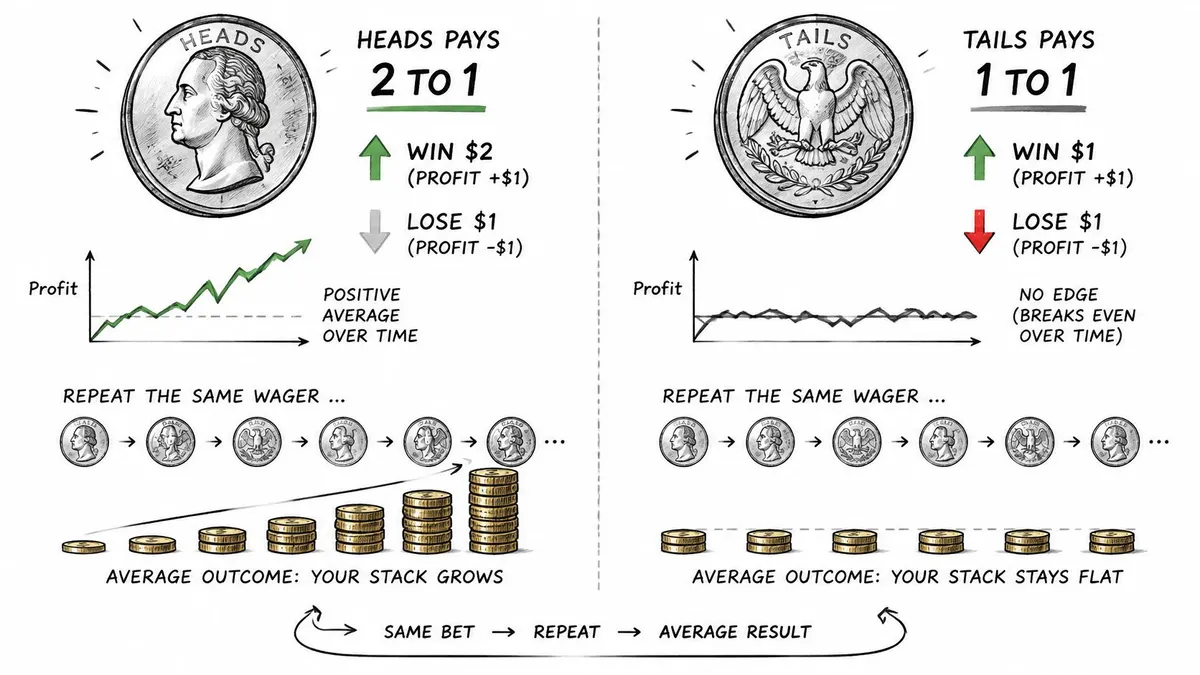
Suppose someone offers a coin-flip game that pays more profit for heads than you lose on tails. With a fair coin, that's an attractive deal. If the profit and loss are equal, neither player has a mathematical advantage.
Expected value, usually shortened to EV, measures that balance. It's the probability-weighted average net result of a wager, not a prediction of what your next bet will return.
The formula is:
EV = (win chance × profit if you win) − (lose chance × stake)
Use profit, not the total payout
The easiest mistake is feeding the wrong winnings into the formula. Your profit if you win excludes the stake returned to you. Including that returned stake would count your own money as earnings and make the bet look better than it is.
Use probabilities in decimal form, then subtract the probability-weighted loss from the probability-weighted profit. For a straightforward wager with no draw, push, or refund possibility, losing chance is the remainder after winning chance.
- Positive result: Your assumptions imply an average profit.
- Zero result: Your assumptions imply break-even before additional costs.
- Negative result: Your assumptions imply an average loss.
The estimate does the difficult work
The arithmetic is straightforward. Deciding what probability belongs in it isn't.
A team can be more likely to win than lose and still be a poor bet if the price is too short. An underdog can lose more often than it wins and still offer positive EV if the payout compensates for those losses.
Practical rule: Don't ask only whether the selection will win. Ask whether the available price pays enough for the chance that it won't.
The word estimated carries the whole concept. A calculator can confirm that your inputs produce a positive answer, but it can't confirm that your probability is justified. That requires a separate, documented judgment.
Turning Odds into Implied Probability
Odds are a price tag written in a different language. Implied probability translates that price into the winning chance needed to break even, before separate fees or taxes.
For positive American odds, divide the standard American-odds stake unit by the quoted odds plus that unit. For negative American odds, divide the absolute quoted odds by that amount plus the standard unit. With decimal odds, take the reciprocal.
These are mathematical conversions, not forecasts. The following hypothetical price lookup shows the relationship between the formats.
Odds formats and their implied probabilities
| American odds | Decimal odds |
|---|---|
| +100 | 2.00, implying 50.00% |
| +150 | 2.50, implying 40.00% |
| +200 | 3.00, implying 33.33% |
| +300 | 4.00, implying 25.00% |
| +500 | 6.00, implying 16.67% |
| -110 | Approximately 1.9091, implying 52.38% |
| -150 | Approximately 1.6667, implying 60.00% |
| -300 | Approximately 1.3333, implying 75.00% |
Remove the margin to build a benchmark
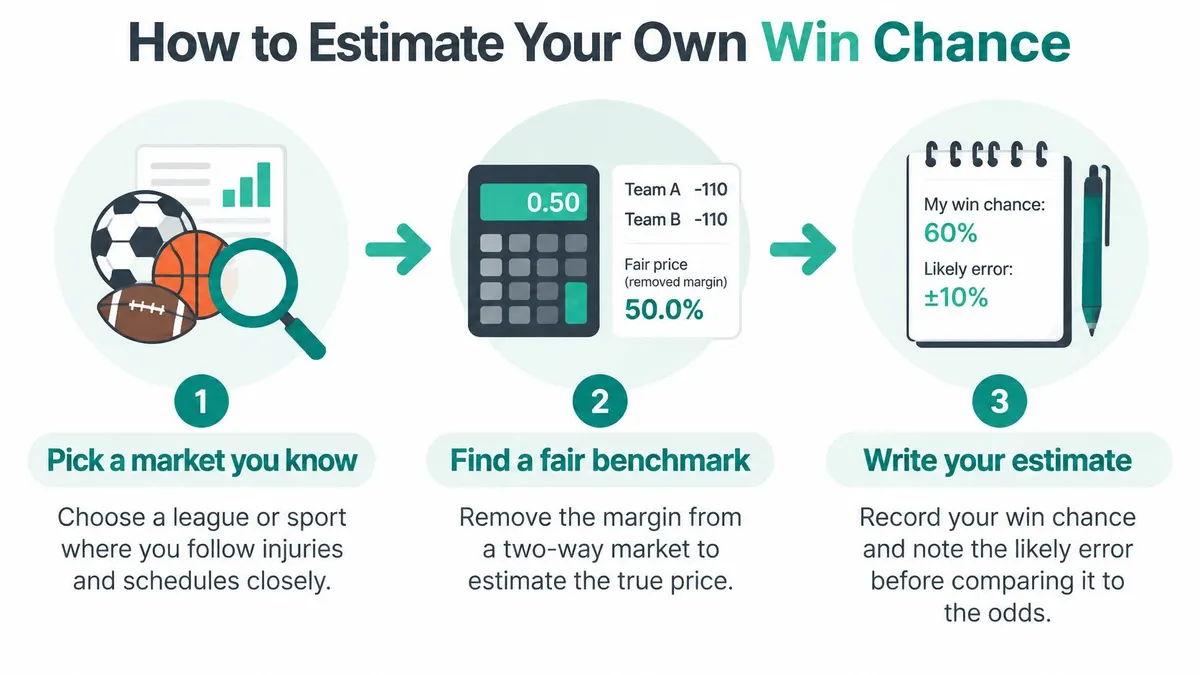
Suppose a hypothetical two-way market offers -110 on each side. Each price implies approximately 52.38%, so together they imply approximately 104.76%.
The amount above a complete probability total is the overround, a measure of the margin built into those prices. It isn't a guaranteed percentage of stakes that the bookmaker will retain.
A simple proportional adjustment divides each implied probability by their combined total. In this symmetrical example, that gives 50% for each side.
That margin-free estimate is useful as a market benchmark, but it isn't proof of the true probability. Proportional margin removal is a practical method, not a way to discover certainty.
Keep two comparisons separate: compare your forecast with a margin-free benchmark to understand your disagreement with the market, then compare it with the actual offered price's break-even probability to calculate EV. Beating a fair benchmark alone doesn't establish that an available bet is worth taking.
How to Estimate Your Own Win Chance
Estimating a probability is like forecasting rain. Knowing the local weather helps, but you still need a repeatable method, and you should expect some forecasts to be wrong.
A useful estimate comes with a written explanation of what would change it. If your reasoning can accommodate every possible result afterward, it wasn't a testable forecast.
Build a forecast you can audit
- Pick a market you understand. Choose a competition where you follow availability, scheduling, and playing conditions closely. Familiarity with team names isn't enough, and supporting a club isn't evidence that you can price its matches.
- Establish a fair benchmark. Remove the margin from a complete market or examine comparable market prices. Check that every quote covers the same outcome, settlement rules, and event period.
- Write your estimate before checking the result. Record how injuries, rest, venue, and recent performances affect your forecast. Avoid counting the same information repeatedly, such as treating a player's absence and the resulting weaker recent form as unrelated disadvantages.
- Describe the uncertainty. Ask how your forecast changes if an uncertain player starts, your underlying ratings are stale, or your interpretation of recent results is wrong. Use a plausible range rather than pretending your preferred estimate is exact.
- Keep an execution log. Record the selection, offered odds, timestamp, intended stake, accepted stake, and reasoning. A spreadsheet is sufficient, provided you also keep bets you considered but couldn't place.
- Review prices and predictions separately. Compare accepted odds with equivalent closing prices, then assess whether outcomes broadly match your forecasts. A favorable price comparison is useful feedback, not a substitute for checking your probability model.
- Revise for a reason. Change assumptions when you identify a repeatable error, not just because an uncomfortable losing spell occurred. Keep earlier model versions so you can distinguish improvement from rewriting history.
A narrow apparent advantage isn't convincing when a reasonable change in your assumptions would reverse it.
Don't set a universal minimum gap and assume it works everywhere. A liquid match market, a poorly documented player market, and an uncertain lineup require different levels of caution. Sometimes the most informative forecast is not enough confidence to bet.
Reading a +150 Bet
Consider a hypothetical sportsbook price of +150 and an estimated 45% chance of winning. With a $100 stake, a win earns $150 in profit, while a loss costs $100. Weight each result by its probability and the expected profit is $12.50, or 12.5% of the stake.
At +150, the break-even probability is 40%, calculated as 100 ÷ 250. The estimate sits five percentage points above that line. Whether the edge survives depends on how reliable the 45% estimate is.
Expected profit on a $100 stake at +150
These hypothetical calculations hold the price and stake constant while varying the assumed true win chance.
| True win chance | Verdict |
|---|---|
| 35% | Negative. Expected profit −$12.50 |
| 40% | Break-even. Expected profit $0.00 |
| 45% | Positive. Expected profit +$12.50 |
| 50% | Positive, larger edge. Expected profit +$25.00 |
At a 45% win chance, the calculation is:
0.45 × $150 − 0.55 × $100 = +$12.50
The first term is the probability-weighted profit from winning; the second is the probability-weighted loss. Expected value is an average across repeated bets, not a promise about this one. A single wager either wins or loses.
A small forecasting error changes the attraction
Suppose the true chance is 41%, not 45%. At the same price and stake:
0.41 × $150 − 0.59 × $100 = +$2.50
The expected value remains positive before further costs, but the apparent edge has nearly vanished. Extra decimal places cannot make a weak probability estimate more accurate.
A guide to calculating payouts explains the difference between returned stake, total payout, and net profit. Those labels keep the arithmetic straight; they do not validate the win probability.
Use the table to see how sensitive the result is, not to pick whichever probability makes the bet look attractive. A +150 price is only an opportunity if your estimate holds up and you can place the wager at that price.
Why Real Markets Shrink the Edge
Research covering more than 5,000 NFL matches found that point spreads and totals captured 86% and 79% of the variation in median outcomes, respectively, according to a study available through PubMed Central. Those findings concern median outcomes, not a bettor's win rate, and illustrate how much information market prices can already contain.
A theoretical bargain resembles a discounted ticket advertised after the seats have sold out. The price may have existed, but you couldn't necessarily buy what your calculation assumed.
Test the bet you can actually place
A backtest can credit every attractive quote. A bettor has to submit a stake, obtain acceptance, and keep the agreed price under the relevant settlement rules.
Execution-adjusted EV means evaluating that attainable wager rather than the most flattering historical snapshot. Start with a defensible probability range, use the accepted price, account for applicable costs, and calculate the expected monetary result at the stake available.
Frictions that erode a theoretical edge
| Friction | Effect on the edge | How to check it |
|---|---|---|
| Stake limits | Caps how much you can bet at the price you found | Test the maximum stake before relying on the edge |
| Price movement | The price you found is gone by the time you bet | Timestamp odds at discovery and placement |
| Rejected or voided bets | Expected profit matters only for wagers that stand | Log rejections, voids, and their stated reasons |
| Commission or margin | Reduces net returns or worsens the offered price | Include margin through the quoted odds, then apply any separate commission |
| Probability error | Your model may overstate the winning chance | Compare forecasts with outcomes across a substantial sample |
Don't subtract bookmaker margin twice. The price already reflects it; a separately charged commission requires its own treatment.
Account restrictions can also make a quoted opportunity inaccessible. Paid information, subscriptions, and the time needed to maintain reliable forecasts belong in your assessment of the activity's overall cost, rather than disappearing because a wager looks positive.
A screenshot of a favorable price is evidence of a quote, not evidence of an executable strategy.
Closing-line value provides another audit: did you obtain better terms than the equivalent market offered near the start? Use it as feedback, not a certificate of future profit.
How large must an apparent edge be to survive uncertainty, slippage, and restricted access? There isn't a universal answer. It must remain positive under a conservative probability assumption, at an available stake and accepted price, after relevant costs.
When Positive EV Still Goes Wrong
A mathematically positive bet can still be a bad personal-finance decision. A favorable average doesn't pay a bill that comes due before your wagers settle.
Think of bankroll as a shock absorber, not a fuel tank you must empty. Money needed for rent, repayments, food, or emergencies isn't available betting capital, however attractive your spreadsheet looks.
Losing runs don't require a broken model
In a hypothetical sequence of independent bets, each with a true 45% win chance, the probability of losing the next five is 0.55⁵, approximately 5.0%. That's the probability of that particular next sequence, not the chance of encountering such a run anywhere across a longer betting history.
Stake-sizing formulas can't eliminate this uncertainty. The Kelly criterion, for example, assumes you know the winning probability and can model the payout correctly. Feeding an optimistic forecast into a formula doesn't make the resulting stake safe.
Financial suitability is a separate test
The Congressional Research Service overview cites research finding that, after four years, average credit scores fell 0.3% in legal sports-betting states and 1.0% in states permitting online betting. Those population-level findings don't isolate positive EV bettors, but they provide important context for treating betting as a consumer-finance decision.
Your own warning signs deserve attention before any model output:
- Borrowed money: Interest and repayment obligations remain even if the bet loses.
- Loss-chasing: Choosing a stake to recover yesterday's loss replaces a plan with an emotional target.
- Correlated exposure: Several wagers depending on the same team, player, or game conditions can lose together.
- Budget drift: Increasing deposits because you believe you've found value can turn a spending limit into a suggestion.
Taxes, where applicable, can also change net results. Keep settlement records and check the rules that apply to you rather than assuming your displayed betting balance represents spendable profit.
Separate mathematical EV, bankroll and liquidity, and entertainment affordability. Passing the mathematical test doesn't excuse failing either financial test.
Gambling content is for adults, and you must meet the legal gambling age where you live. If betting stops being enjoyable, you conceal spending, or you struggle to stop, pause and seek local gambling-support services rather than searching for a better staking formula.
Confirm the Edge Before Your Next Bet
Pass on the wager if any essential check fails. The purpose of a pre-bet checklist isn't to make every selection look acceptable. It's to give you a consistent reason to decline one.
Treat it like checking a boarding pass: the destination alone isn't enough. The date, departure time, and passenger details also have to match.
Use a written decision checklist
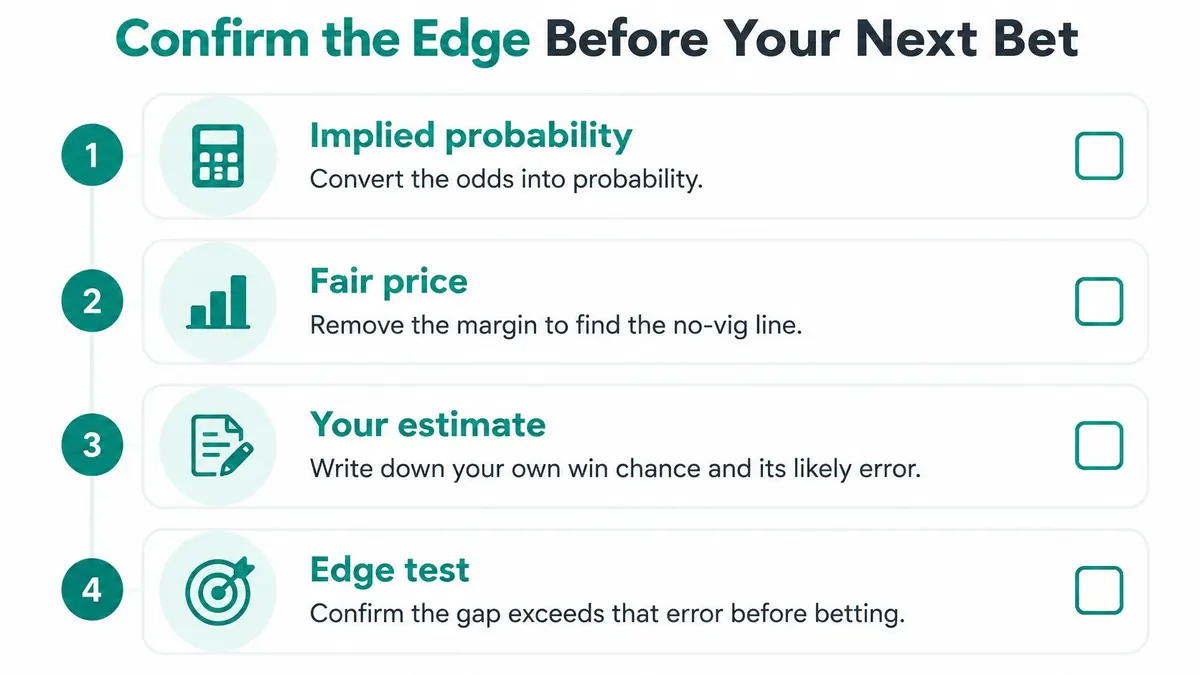
- Implied probability: Convert the available odds into their break-even probability without confusing payout with profit.
- Fair benchmark: Remove the market margin to understand the baseline against which you're disagreeing.
- Documented estimate: Write down your forecast, its reasoning, and a plausible error range.
- Conservative advantage: Confirm that a conservative version of the forecast still supports the offered price after relevant costs.
- Affordable stake: Check both the accepted stake limit and your predetermined bankroll and entertainment limits.
- Current quote: Timestamp the price and verify it at submission rather than relying on an earlier display.
- Matching terms: Confirm the event period, settlement rules, and treatment of withdrawals, cancellations, or pushes.
Use information tools without outsourcing the decision
We provide ScanOdds as a free sports site, with an Odds converter, Margin calculator, Bet calculator, Value bets, Dropping odds, and Payout ranking, alongside fair-odds calculations and consensus market averages. Use these as inputs for checking prices and assumptions, not as a verdict that a wager will be profitable.
Our tips are our reading of the data, not advice, and we publish how earlier tips turned out. We make no promises of winnings or sure bets, and we don't present betting as a skill or a source of income.
The final decision rule is deliberately demanding: consider a wager only when the price, probability, execution, and affordability checks all hold. An unverified edge is a reason to wait, not a reason to increase your stake before the opportunity disappears.
Visit ScanOdds to use our odds conversion and margin tools, compare market information, and check the arithmetic behind an apparent positive EV opportunity. Write down your probability estimate and spending limit first, then use the available information to test your assumptions rather than justify a bet you've already decided to make.