Odds Payout Calculator for Profit and Returns
An odds payout calculator shows return and profit for decimal, fractional and American odds, then what parlays, voids and tax do to the cash.
The usual advice is to enter your stake, multiply by the odds, and admire the payout. That's fine for arithmetic and lousy for judging a bet. A giant return can hide a worse price, and the number on a calculator isn't necessarily the amount you'll withdraw.
Treat an odds payout calculator like a till, not a crystal ball. It should separate your stake from your profit, expose the assumptions behind a chunky accumulator, and help you decide whether to keep your money in your pocket.
Table of Contents
- What a Hundred Dollars Comes Back As
- Three formats, one ticket
- Scale the stake, not your expectations
- How to Run the Odds Payout Calculator
- Enter the ticket accurately
- Add the checks a basic result leaves out
- Gross Return Versus Cash Received
- Bigger return, potentially worse value
- What changes the calculator figure
- Read deductions and offers literally
- Tips That Keep a Big Price Honest
- Separate a threshold from a prediction
- Keep the stake independent of the sales pitch
- Price One Real Stake Before You Bet
- Make the decision before sending money
- Use information without mistaking it for a promise
What a Hundred Dollars Comes Back As
A winning ticket that returns your money plus winnings hasn't made you that entire amount in profit. Your original stake is in there too, wearing a party hat.
Start with this hypothetical $100 stake lookup. Every money cell shows gross arithmetic before tax, fees, voids, promotional adjustments or cash-out. The decimal price appears beside the price description so equivalent formats stay together.
Return and profit on a $100 stake
| Price feel and decimal equivalent | Fractional | American | Gross return | Profit |
|---|---|---|---|---|
| Even money, 2.00 | 1/1 | +100 | $200 | $100 |
| Near even with juice, approximately 1.91 | 10/11 | -110 | About $190.91 | About $90.91 |
| Solid underdog, 2.50 | 6/4 | +150 | $250 | $150 |
| Double your stake as winnings, 3.00 | 2/1 | +200 | $300 | $200 |
| Longshot, 6.00 | 5/1 | +500 | $600 | $500 |
| Short favourite, 1.50 | 1/2 | -200 | $150 | $50 |
These are worked conversions, not available offers or predictions. In particular, 1.91 is rounded: the exact decimal equivalent of -110 or 10/11 continues beyond those displayed digits. Entering the rounded decimal can therefore produce a slightly different result from entering the original price.
Three formats, one ticket
Decimal odds multiply the whole stake to calculate gross return. Fractional odds describe profit relative to stake, so you add the stake back afterward to find the return. American odds use a reference stake: positive prices describe profit on $100, while negative prices describe the stake required to win $100.
That's why a negative American price doesn't mean negative winnings. It means you're risking more than the reference profit amount. Dropping the minus sign changes the price, not merely its appearance.
The formats are different ways of writing the same bargain. A favourite doesn't become better value because you switch the display from fractional to decimal, just as changing a price tag's currency doesn't magically create a discount.
Read the receipt: Gross return is what comes back on a winning ticket. Profit is what remains after subtracting what you put in.
Scale the stake, not your expectations
For this hypothetical table, multiply the return and profit by your stake divided by $100. The relationship is proportional: cutting the stake cuts both possible winnings and the amount at risk. It doesn't improve the underlying price.
Keep currency consistent throughout. A calculator displaying a dollar symbol doesn't convert a stake funded in another currency, and a converted account balance may involve separate charges.
When checking a match such as Fenerbahce Istanbul versus Slavia Prague, identify the exact market and selection before borrowing a price for your calculation. Match winner, handicap and total-goals selections aren't interchangeable just because they belong to the same fixture.
Then choose the row that matches the price on your ticket. Don't choose the row with the biggest profit and work backward toward a reason to bet.
How to Run the Odds Payout Calculator
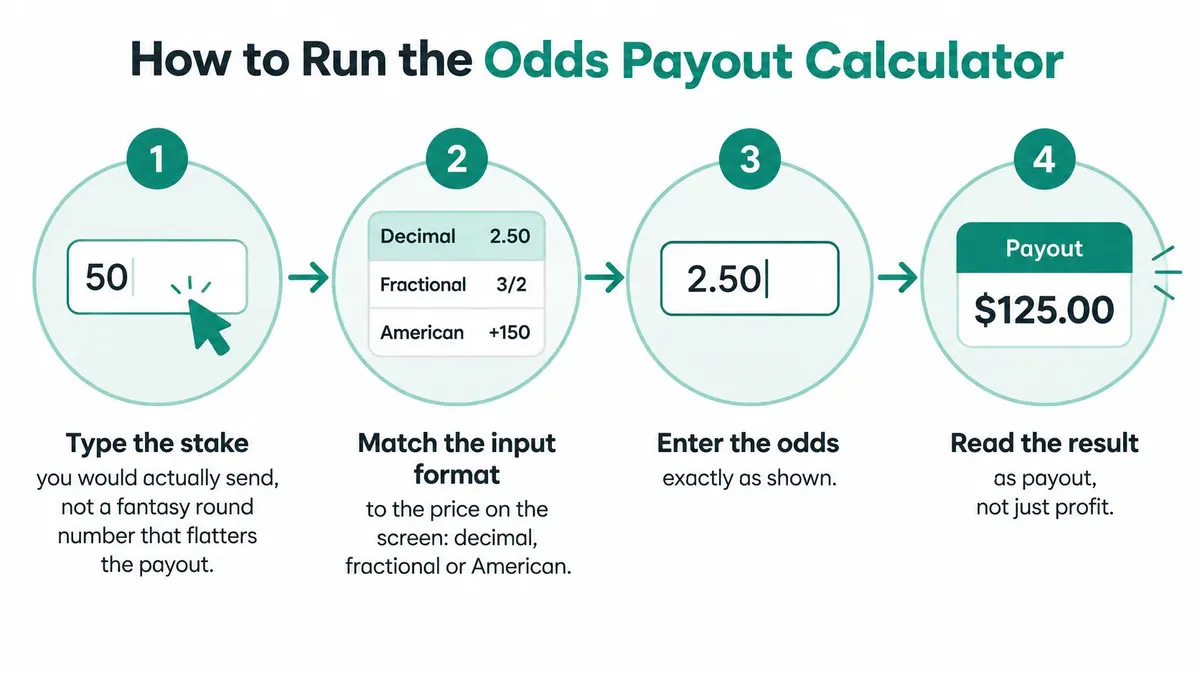
Use a stake you'd consider losing, not a decorative amount chosen to make the result look impressive. For a running hypothetical example, say you're pricing a $25 single at decimal odds of 2.40.
The basic input sequence is straightforward.
Enter the ticket accurately
- Type the actual stake. Enter $25 for this example. If you later decide to risk less, change the input rather than mentally adjusting a result you've already become attached to.
- Select the correct odds format. Choose decimal for 2.40. This tells the calculator how to interpret the characters you're about to enter.
- Copy the price exactly. Enter 2.40 without rounding it for convenience. With American favourites, preserve the minus sign; removing it can turn a modest potential profit into a completely different calculation.
- Read gross return first. In this example, $25 × 2.40 produces $60 gross return if the selection wins under ordinary settlement. That's the amount including the returning stake, not an extra payment on top of it.
- Check the profit field. Subtracting the $25 stake leaves $35 profit before adjustments. If the interface says winnings without defining the term, check whether it means this figure or the gross return.
The equivalent hypothetical entries 7/5 and +140 produce the same result when entered in their matching formats. You don't need to convert them manually first if the calculator supports the format printed on your ticket.
Add the checks a basic result leaves out
- For an accumulator, separate the legs. Put each selection on its own line and let the calculator convert prices to decimal before multiplying. Never add American numbers or fractional numerators together; that creates a number without a meaningful payout interpretation.
- Label any implied probability carefully. Save it as the price's break-even rate, not your personal likelihood of winning. A calculator can derive a threshold from odds without knowing anything about the teams, players or conditions.
- Save a small calculation record. For the running example, record gross return of $60 and profit of $35, then add a note that margin is included in the price and a separate space for an alternative settlement scenario.
That record makes later changes visible. If the accepted price differs from the price you typed, recalculate rather than relying on the earlier screenshot.
Before leaving the page, check the format dropdown after every paste. A fractional price dropped into a decimal box can create a nonsense ticket with a perfectly confident-looking answer.
Gross Return Versus Cash Received
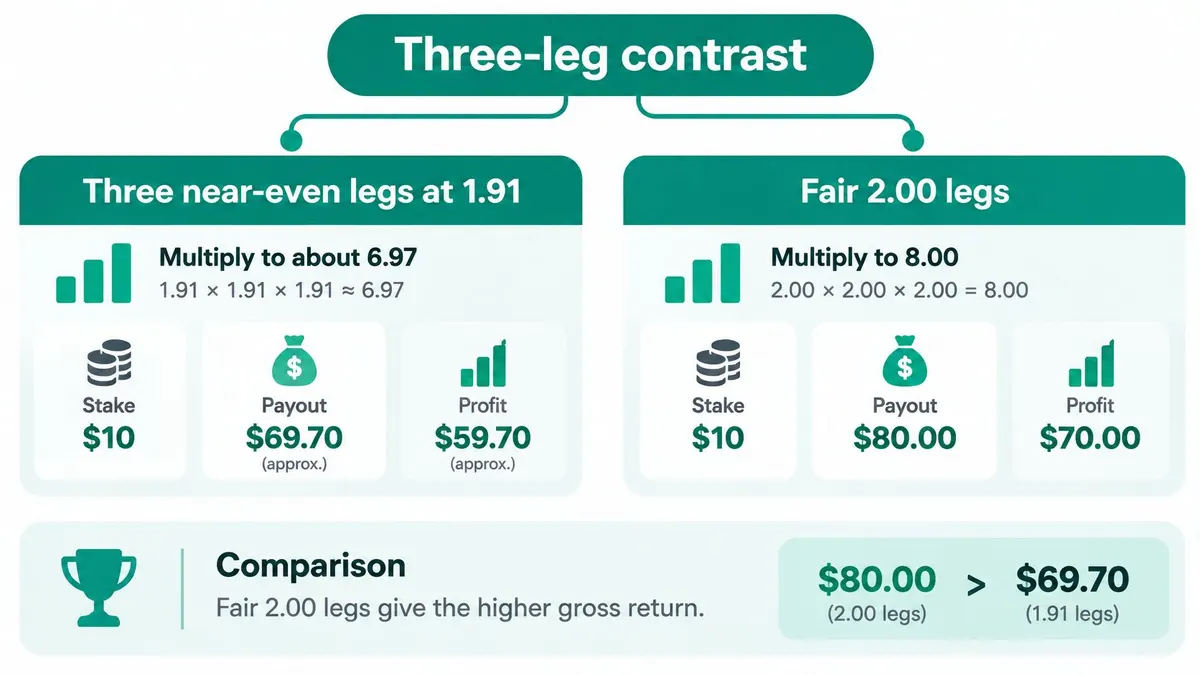
Consider a hypothetical parlay of three independent selections at 1.91 each, backed with $10. Multiplying the prices gives approximately 6.97, producing about $69.68 gross return and $59.68 profit before deductions. A display rounded earlier in the calculation might show roughly $69.70, but the principle is unchanged.
Now suppose those selections each have an even chance and fair decimal odds of 2.00. Their fair combined price would be 8.00, returning $80 on the same hypothetical stake. The approximately $10.32 return gap illustrates how a price disadvantage compounds across independent legs.
The comparison is shown visually below. Its rounded figures illustrate the contrast rather than a guaranteed settlement.
Bigger return, potentially worse value
Adding selections can make the advertised payout louder while making the price less attractive relative to fair odds. The important comparison isn't just how much you could win. It's how much the offered price pays relative to the actual difficulty of winning.
That distinction matters for a common wager: roughly one-quarter of surveyed bettors said parlays were their most frequent wager in 2025, according to the U.S. News sports betting and debt survey.
However, don't mistake the hypothetical return gap for a measured bookmaker margin. You can't determine a fair probability from a selection's offered odds alone. Estimating embedded margin requires additional market prices, a stated method for removing overround, or your own defensible probability assumptions.
For related selections, there's another complication. If the outcome of one leg affects another, multiplying their individual probabilities doesn't establish the combined chance. Use the operator's actual accepted combination price for payout arithmetic, and don't present a simple independent-leg model as fair valuation.
Ask for these four outputs, whether the calculator supplies them or you keep them alongside it:
- Gross return. The winning return under the entered price and settlement assumptions.
- Net profit. Return minus your original outlay, with deductions identified separately.
- Estimated embedded margin. A comparison against an explicitly stated fair-price benchmark, not a mystery percentage.
- Adjusted settlement range. Conditional results for relevant changes, with a losing-ticket outcome kept visible too.
What changes the calculator figure
The ordinary multiplication is only one settlement case. Read the alternatives before treating the largest result as spendable money.
| Case | What the calculator assumes | Cash to expect |
|---|---|---|
| Straight win | Every selection wins at the entered price | Gross return, stake included, before applicable deductions |
| Pushed or voided parlay leg | All legs stay in the multiple | Return recalculated using the surviving legs under the ticket's rules |
| Stake tax or commission | The full stake is priced | If deducted from stake, odds apply to a smaller amount, reducing return and profit against the original outlay |
| Tax on winnings | Profit equals return minus stake | Profit left after applicable withholding or tax obligations where you live |
| Partial cash-out | The ticket runs to the end | Immediate offered cash for the portion cashed out, plus a residual ticket if only part is closed |
| Promo minimum-odds miss | The boosted price stands | Boost removed or another outcome specified by the promotion's terms |
In the hypothetical parlay, voiding a leg and retaining the other two 1.91 selections produces combined odds of 3.6481. On the original $10 stake, that means approximately $36.48 gross return, assuming the rules remove the void leg without another adjustment.
That's a very different receipt. A void doesn't necessarily refund the entire accumulator, and special-market rules can produce a different treatment.
Read deductions and offers literally
A full cash-out closes the whole ticket for the accepted offer. A partial cash-out usually closes only part, leaving a reduced ticket exposed to the remaining outcomes. Don't count both the full original potential return and the cash-out payment, and check exactly what remains open before confirming.
Taxes and commissions also need careful labels. A charge deducted from the stake reduces the amount receiving the odds multiplier; a separate charge increases your total outlay instead. Tax withheld from winnings affects immediate cash, while a later tax obligation may affect what you can sensibly keep.
Currency conversion can reduce the amount arriving in your chosen currency. Withdrawal limits may restrict how much you can move at once rather than reduce your entitlement, so separate amount payable from amount immediately withdrawable.
Promotional conditions deserve the same literal reading. Missing a minimum-odds requirement might remove a boost, invalidate a bonus-related wager or trigger another specified settlement. Don't assume every failed condition returns the stake.
A mathematical estimate is not a guaranteed withdrawal, even when the calculator displays it to the penny.
Record both the ordinary winning settlement and the relevant adverse adjustment. If you insist on planning around a conditional winning figure, use the lower one, but don't budget for either: a losing ticket can still return nothing.
Tips That Keep a Big Price Honest
A larger payout can hide worse value. With a multi-leg bet, the combined price can look exciting while the margin built into each leg weighs on the overall return. Check more than the headline number: stake, gross return, net profit, embedded margin and any adjusted settlement range.
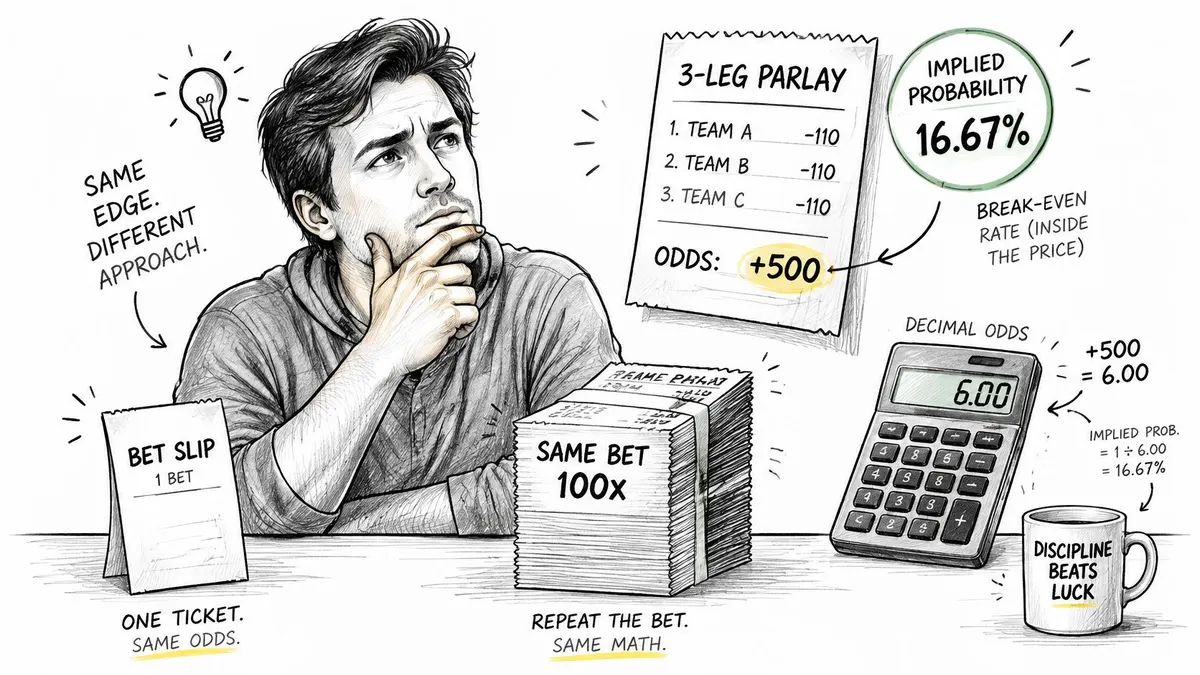
A three-leg parlay at +500 implies a break-even threshold of about 16.67%: 100 ÷ (500 + 100). That figure comes from the displayed price. It does not show that the price is fair or predict whether the ticket will win.
Separate a threshold from a prediction
A single and a parlay at identical odds return the same amount for the same stake if they win. Their chances can differ. A parlay needs every leg to succeed, and estimating its chance means assessing each leg and any relationship between them.
The displayed price already reflects the pricing used for the wager. For an unadjusted cash bet, it sets the break-even threshold. Fees or deductions can raise the win rate needed to break even. Don't treat a guessed margin adjustment as a more accurate threshold.
If you have a defensible probability estimate, calculate expected value:
Expected value = estimated win probability × winning net profit − estimated loss probability × stake.
Use profit after relevant deductions and the actual amount lost on failure. This is a modelled average across repeated comparable bets, not a promise about the next result.
Keep the stake independent of the sales pitch
Without a defensible probability estimate, skip the edge calculation. Confidence dressed up as a formula is still a guess.
- Set a loss budget first. Keep gambling money separate from rent, bills, debt payments and essential savings.
- Set a small fixed stake ceiling. Use a lower ceiling for speculative combinations rather than raising it because the potential return looks exciting.
- Add up the losing case. Calculate the cash committed if every planned wager loses, then decide in advance whether you can accept that outcome.
- Don't finance another attempt. A previous loss doesn't improve the next ticket's chance or justify borrowing to continue.
For a hypothetical monthly exercise, twenty $10 wagers commit $200. That total is exact; the number of wins needed to recover it is not something you can schedule. A positive estimated average cannot prevent losses from arriving close together.
For a matchup such as Carolina Hurricanes versus Florida Panthers, separate your opinion about the game from your assessment of a particular market's price. Enjoying the matchup is not a probability model.
Useful stopping point: The calculation is finished when the profit, break-even requirement and affordable stake all look boring enough to accept without negotiation.
Price One Real Stake Before You Bet
Choose a stake you could lose without moving money out of an essential category. Not an amount you could replace after payday, and not an amount that becomes affordable only if the ticket wins. If losing it changes your weekend plans in a way you'd resent, reduce it or stop.
Take the actual price attached to the exact selection you're considering. For an event such as Matteo Arnaldi versus Lorenzo Musetti, verify the market wording and settlement conditions rather than assuming every tennis selection receives identical treatment.
Make the decision before sending money
Write a short decision record before opening the betting confirmation screen. Keep it practical enough that you'll use it.
- My maximum acceptable loss. The full cash outlay, including any separately charged costs.
- My conditional winning result. Gross return and profit, clearly distinguished.
- My changed-settlement result. The relevant void, deduction or promotional alternative.
- My reason to decline. The price, uncertainty or stake concern that would make skipping the wager the sensible choice.
If the profit only looks appealing after multiplying several short prices, pause. You haven't discovered extra value merely by creating a larger number. Ask whether you'd still accept the individual selections without the excitement of the combined payout.
Use the lower conditional result as a cautious comparison, never as money already available. The practical decision is whether the possible reward justifies an affordable loss, not whether the calculator can produce a handsome screenshot.
Use information without mistaking it for a promise
We offer a Bet calculator, Odds converter and Margin calculator on ScanOdds, a free sports site. These tools let you check the arithmetic, translate the price format and examine market pricing without treating a potential return as a prediction.
We're not a bookmaker. You can't place bets on our site, we hold no money and we have no customer accounts. Nothing on the page promises winnings, and gambling-related content is for adults aged 18 and over, subject to applicable local restrictions.
The calculator's job is to spoil a fantasy payout before it spoils a weekend. If the adjusted result no longer feels worth the money at risk, close the ticket. Skipping the bet is a completed decision, not an unfinished calculation.
ScanOdds offers free calculation and conversion tools to help you separate potential return from profit and inspect the price behind a ticket. Visit ScanOdds to check one real stake, compare the relevant settlement scenarios, and decide whether to proceed or keep the money.