Pak vs Afg Live: Scores, Status and Key Updates
Pak vs Afg live score, match status and key in-game updates explained. Read the score line, check the status and find where to watch by country.
The chase ended at 286 for 2 in 49 overs. On 23 October 2023 in Chennai, Afghanistan reached that target of 282 for 7 with six balls left, winning by eight wickets.
That scoreline belongs to a men's ODI. A search for Pak vs Afg live can also surface football draws or finished T20 matches, so check the sport, format and status before reading the figures.
Table of Contents
- Confirm the Sport, Format and Live Status
- Match status labels and what to check
- How to Read the Live Score Line
- Live score fields with a worked example
- In-Game Updates That Change the Match
- Partnerships, the bowler and a stoppage
- Players Who Shift a Live Match
- ODI and T20I Differences for Live Tracking
- Keep the head-to-head split
- Head-to-Head Results Behind Every Live Match
- From Fatullah to Chennai
- Where to Watch Pakistan vs Afghanistan Live
- 2025 viewing routes by market
- Follow the Match and Avoid Common Errors
- Four mistakes that waste a refresh
Confirm the Sport, Format and Live Status
A scorecard can show runs, goals or a finished result. Before reading any number, check its sport, format and status. Search Pak vs Afg live, and results may mix cricket with football or show completed matches alongside games in progress.
Check the sport first. Pakistan and Afghanistan can meet in different sports, so confirm the match is cricket before reading the score. A football scoreline belongs to a different contest.
Then check the format. A 20-over T20I and a 50-over ODI have different limits and call for different readings of the match. In the 2025 UAE tri-series, Afghanistan beat Pakistan by 18 runs in a league match, then Pakistan beat Afghanistan by 75 runs in the final. Those margins belong to T20 cricket, not a 50-over chase.
Finally, check the status. A full score beside a live-style header may be a completed result, not a match in progress. No confirmed upcoming senior men's Pakistan-Afghanistan cricket fixture is listed, so a trending search phrase alone does not mean play is underway.
Match status labels and what to check
| Status label | What it means | What to check |
|---|---|---|
| Scheduled | Match has not started; start time is set | Confirm venue, date and local start time on the official scorecard |
| Toss | Captains have tossed and chosen to bat or field | Check the confirmed playing XI and the batting side |
| In progress | Overs are being bowled and the score updates ball by ball | Compare overs completed with the format limit of 50 or 20 |
| Innings break | First innings is complete and a target has been set | Note the target and the required run rate |
| Delayed or interrupted | Rain or light has stopped play; overs may be reduced | Check revised overs and any revised target |
| Completed | Result is decided and the margin is shown | Check the margin and the final scorecard, not the live feed |
| No result or abandoned | Match ended without a finish | Check the competition rules and any rescheduled date |
A Completed label saves you from refreshing a feed after the final ball. Check the result, then look for a confirmed fixture and its local start time.
Practical rule: If the header doesn't name the sport, the competition and a status, don't trust the number under it.
How to Read the Live Score Line
Once the match is an ODI and the status says in progress, the score line is a small machine. Under the ICC men's ODI playing conditions, an innings is limited to 50 overs, and the state of the match is runs, wickets, overs completed, required run rate and target.
Take a tight Asia Cup finish as the working model. Pakistan reached 258/7 after 49.3 overs while Afghanistan had made 257/6 in 50 overs, and Pakistan won by three wickets, which is the level of precision a Pakistan vs Afghanistan scorecard has to keep. 49.3 is not a decimal. It is 49 completed overs plus three legal balls. Store it and say it that way. Treat it as 49.3 out of 50 in the maths-class sense and you'll miscount the balls left by a whole over's worth of panic.
Live score fields with a worked example
Say you're watching the 2023 World Cup chase in Chennai, the one people still quote when these teams meet. Read the fields in order.
| Live field | Example | How to read it |
|---|---|---|
| Innings total | Pakistan 282/7 in Chennai, 2023 | Runs scored for the loss of seven wickets in 50 overs |
| Overs completed | 49.3 | 49 completed overs plus three legal balls, not a decimal |
| Target | 283 | Set total of 282 plus one run |
| Required run rate | 100 runs from 20 overs | 5.00 runs per over |
| Wickets in hand | 8 wickets remaining | 10 minus wickets already lost |
| Chase result | Afghanistan 286/2 in 49 overs | Won by eight wickets with six balls remaining |
282/7 means seven wickets lost across the full 50. The chase starts at 283, one more than that total, not at 282. 286/2 in 49 overs means the target was passed with two wickets down and six balls still unused, which is an eight-wicket win.
The rate is ordinary arithmetic. 100 runs from 20 overs is 5.00 an over. If the scoring rate sits under that number for a few overs, the chase is tightening even when the total still looks comfortable. Wickets in hand are the other half: 10 minus wickets already lost. Eight in hand is a different game from three in hand at the same rate.
Wides and no-balls add runs without being legal deliveries, so an over can run past six balls and the over count must not tick forward. A useful feed also separates innings status, striker, non-striker, bowler, partnership, extras and the fall of wickets.
In any live over, read two fields before the rest. Runs still needed, then balls left. Everything else is commentary on those two.
In-Game Updates That Change the Match
A quiet over can look like nothing until you see what it did to the chase. These are the updates that move the match, in the order they usually bite.
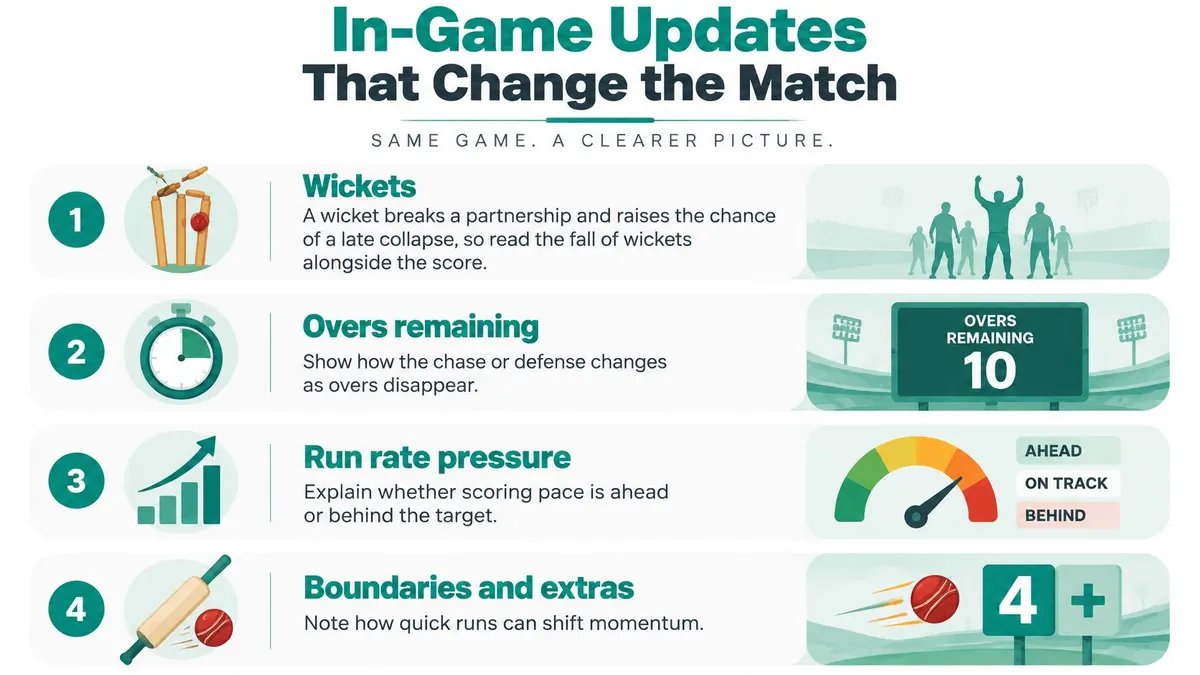
A wicket is the loud one. It ends a partnership and lifts the chance of a late collapse, so read the fall beside the over it happened in. What changed is one batter, not the whole total. The target in runs stays the same, but the batters who have to get there are new. In the next over, watch whether the new batter farms the strike or gets stuck on the first few balls.
A boundary does quieter maths with a bigger swing. A four or a six removes balls from the requirement faster than singles can. Two sixes in an over can drop the required rate by a run or more when the overs left are already short. What to watch next is whether the bowler changes length, because a single pulled back to midwicket gives the rate straight back.
Extras are the update people miscount. A wide or a no-ball puts runs on the board and is not a legal ball, so the over keeps going. The target shrinks without the over count moving. Watch the next legal ball, not the freebie, if you want to know whether the bowling side really slowed the chase.
Partnerships, the bowler and a stoppage
A stand around fifty or more in a chase rewrites the requirement, the way a long opening stand did in that 2023 chase before the middle overs even started. What changed is the platform, not one shot. The rate drops while wickets in hand stay high. Watch the first over after a wicket in that stand, because that's when the platform either holds or cracks.
Note the striker, non-striker and bowler every over. A set batter at the death changes the picture more than a fresh one facing the same bowler. Check how many overs that bowler has left. One over left is a different threat from three.
Rain or bad light can cut the innings and reset the target under the playing conditions. What changed may be the length of the game itself. Write down the revised overs and the revised target before you trust the old rate. The next over only counts once the umpires have confirmed the new math.
Players Who Shift a Live Match
The card moves when a role shows up, not when a famous name is merely in the XI. There is no live XI in front of you until the official scorecard confirms it, so don't treat last month's hero as today's factor.
On the Pakistan side of that 2023 World Cup innings, the top order carried the total, so the early loss of either opener matters more than the score suggests. In the 2025 UAE final, ESPN's scorecard shows Fakhar Zaman scored 27 from 26 balls. That isn't a headline knock. It's a reminder that a steady scoring rate can hold an innings together while a spell at the other end does the damage. A four-over burst from a spinner can fold a batting side before the death overs arrive. You see that in the fall of wickets, not in the run column.
Afghanistan's 2023 chase was built at the top, so check whether the opening pair is still in when the powerplay ends. For each live over, track the current striker, non-striker and bowler, and how many overs that bowler has left.
Judge pressure by the job, not the reputation. An opener who has batted through the powerplay is a different problem from a middle-order batter facing spin, or a death bowler with one over left.
ODI and T20I Differences for Live Tracking
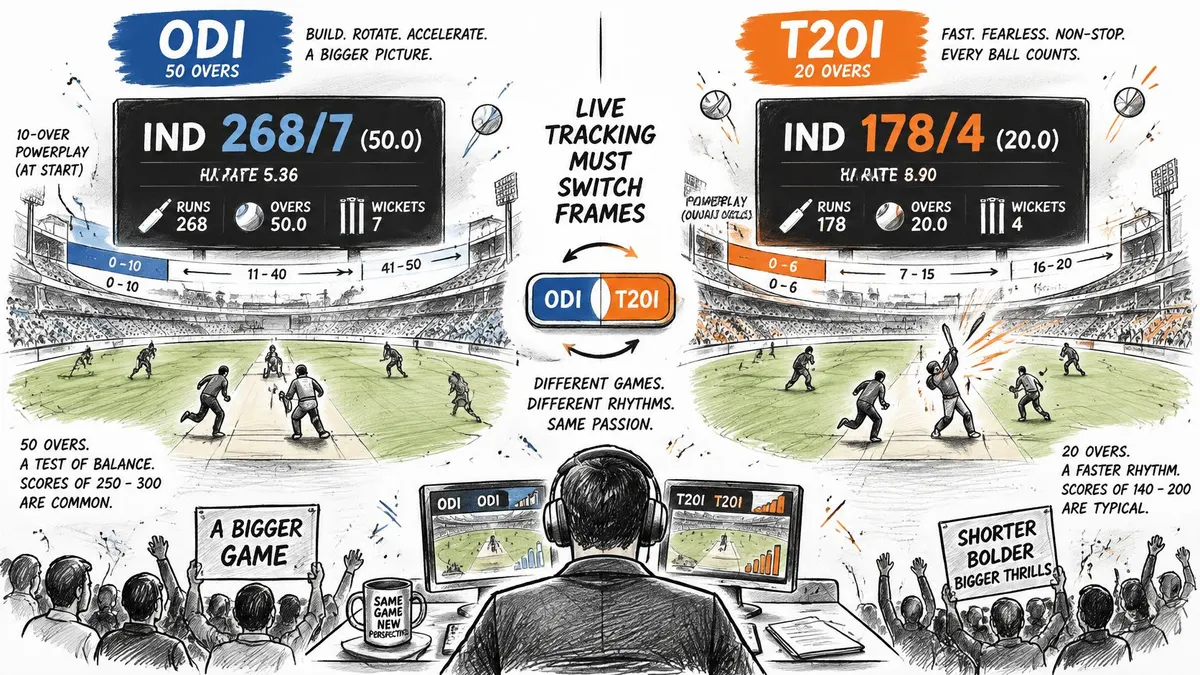
Before a score means anything, settle the format and whether play is live. Say a café owner checks a Pakistan vs Afghanistan page during an ODI, then opens a T20I score by mistake: the same runs can signal very different pressure.
An ODI allows each side 50 overs. In the 2023 World Cup, Pakistan made 282/7 from 50 overs, then Afghanistan chased the target with 286/2. The Sky Sports scorecard for Pakistan vs Afghanistan at the 2023 World Cup records the eight-wicket result. Read the score line as separate pieces: runs scored, wickets lost, overs faced and, during a chase, the target and runs still required.
A T20I allows 20 overs per side. Its shorter innings make each over loom larger, especially late in the chase. A wide or a pair of sixes can quickly change the required rate.
Keep the head-to-head split
Pakistan and Afghanistan have met in several T20 internationals, most recently in the 2025 UAE tri-series, as the head-to-head table above shows. Keep those results separate from their ODI record. For a live match, read the format in front of you: target, runs required, balls remaining and wickets in hand give the chase its shape.
- In a T20I, watch the required rate and balls remaining. A quiet over near the end can tighten the chase.
- In an ODI, wickets in hand and overs left help explain the middle overs. A rate of six with eight wickets left reads differently from the same rate with three wickets left.
- On the page, check the competition, venue, scheduled start, toss and confirmed XI before interpreting the score or any price beside it.
Check the format label, overs limit and any rain-adjusted target. Without those, the score line can mislead.
Head-to-Head Results Behind Every Live Match
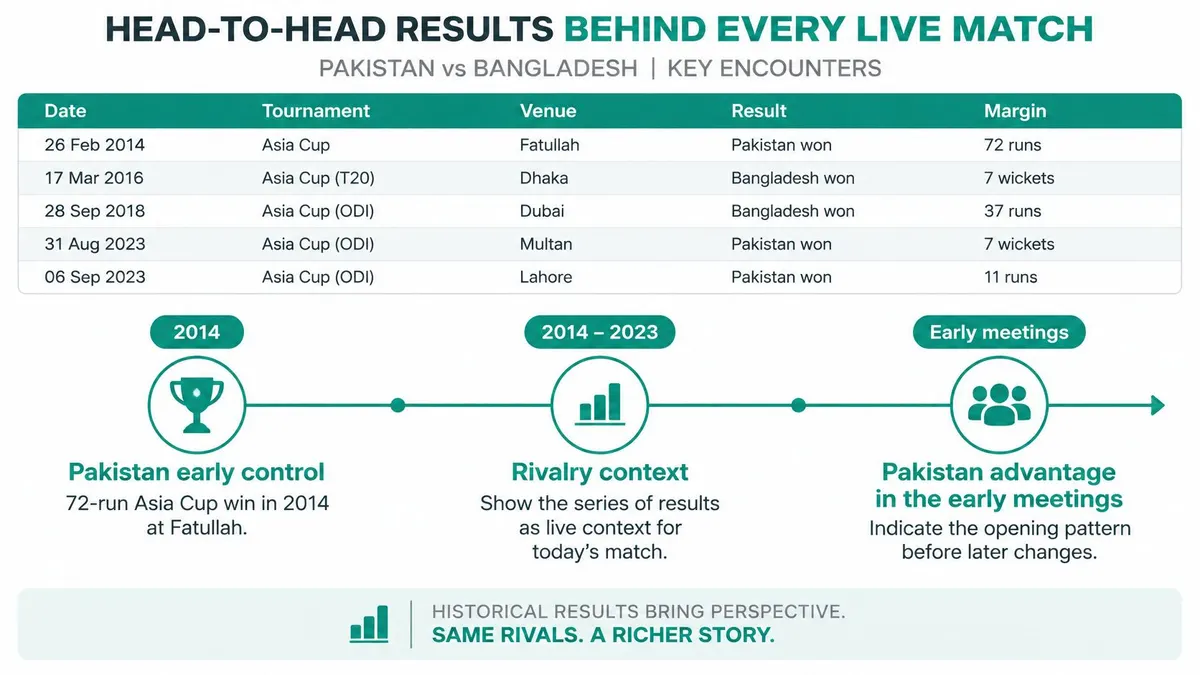
History can sharpen the picture, but the format matters: an ODI chase in Chennai and a T20I final are different tests.
| Date | Competition and format | Result | Key figure |
|---|---|---|---|
| 27 Feb 2014 | Asia Cup, ODI, Fatullah | Pakistan won by 72 runs | Pakistan 248/8; Afghanistan dismissed for 176 in 47.2 overs |
| 2018 | Asia Cup Super Four, ODI, Abu Dhabi | Pakistan won by three wickets | Afghanistan 257/6 in 50 overs |
| 23 Oct 2023 | ICC Cricket World Cup, ODI, Chennai | Afghanistan won by 8 wickets | Pakistan 282/7; Afghanistan 286/2 in 49 overs |
| 2 Sep 2025 | UAE T20I Tri-Series, league match, T20I | Afghanistan won by 18 runs | Margin of 18 runs; innings totals not listed in the match note |
| 7 Sep 2025 | UAE T20I Tri-Series final, T20I | Pakistan won by 75 runs | Afghanistan dismissed for 66 in 15.5 overs; Mohammad Nawaz 5 for 19 |
From Fatullah to Chennai
Pakistan won the early meetings listed here. At the 2014 Asia Cup in Fatullah, Pakistan scored 248/8 and dismissed Afghanistan for 176 in 47.2 overs, winning by 72 runs, according to the BCCI record of the fixture. In the 2018 Asia Cup Super Four at Abu Dhabi, Afghanistan made 257/6 in 50 overs, but Pakistan won by three wickets.
Chennai brought a different finish. On 23 October 2023, Afghanistan chased Pakistan's 282/7 and reached 286/2 in 49 overs. Ibrahim Zadran scored 87 from 113 balls, Rahmanullah Gurbaz made 65 from 53, and Rahmat Shah finished unbeaten on 77 from 84. Their opening stand of 130 put the chase on course before the middle overs. Pakistan's leading scores were Babar Azam's 74 from 92 and Abdullah Shafique's 58 from 75, in the Sky Sports report of the eight-wicket result.
The 2025 T20I tri-series offered a sharp contrast. Pakistan won the final by 75 runs on 7 September, with Afghanistan all out for 66 in 15.5 overs, according to ESPN's match report. ESPN's final statistics show Mohammad Nawaz took 5 for 19 in four overs.
Read the scorecard by format. Afghanistan's Chennai chase is an ODI reference; Pakistan's final-day bowling performance belongs to T20I history. Neither result decides the next match, but each shows how quickly this fixture can turn.
Where to Watch Pakistan vs Afghanistan Live
For the 2025 Asia Cup, viewing rights varied by country. A broadcaster available for one fixture or market may not carry the next. Check the official broadcaster or Pakistan Cricket Board (PCB) page for the specific match.
In October 2025, the PCB launched PCB LIVE, a direct-to-consumer platform for live and on-demand Pakistan cricket, with a pilot in the United Kingdom and mobile support planned, according to the PCB press release.
2025 viewing routes by market
| Market | What to check | Action |
|---|---|---|
| Pakistan | Official broadcaster or PCB page | Confirm the fixture |
| Afghanistan | Official broadcaster or PCB page | Confirm the fixture |
| United Kingdom | PCB page for the PCB LIVE pilot | Check whether the fixture is included |
| UAE | Official match notice | Confirm the fixture |
| Diaspora markets | Official broadcaster or PCB page for your country | Check the local listing |
For each market, confirm the local start time, whether the fixture is available, any subscription requirement and any blackout. ScanOdds' TV guide lists channels and streaming services with rights in your country. Check the fixture with the broadcaster or PCB before setting a reminder. “Live stream” alone does not tell you whether the match is available where you are.
Follow the Match and Avoid Common Errors
A score can be accurate and still mislead if the match status is wrong. Check the sport, format and live status first, then read the figures against the right innings and target.
If the match is in progress, use the official scorecard to confirm overs completed, the target and the required rate. Runs needed and balls remaining give the chase its shape; a partnership graphic alone does not.
If play has not started, check the confirmed fixture and local start time before setting a reminder. Alerts for wickets or changes in the required rate can help you follow key moments without treating every refresh as a turning point.
Four mistakes that waste a refresh
A stale score can look live even when a page has stopped updating. After a wicket or review, check the official scorecard rather than refreshing a secondary page repeatedly.
Confusing the target with the score is an easy mistake during a chase. In the Chennai example, the target was 283, one more than 282; it was not Afghanistan's total. Keep the target separate from the runs already scored.
A completed match labelled live can make an old result look close. Check the status and timestamp, then look for the next fixture if play has ended.
A secondary feed updating first is still a prompt to verify, not the final record. Treat screenshots and other feeds as provisional until they match the official scorecard.
Read the status label first, then confirm the overs. If those disagree with the headline total, check the scorecard before drawing a conclusion.
For sports ScanOdds covers, ScanOdds provides live scores, fixtures and results. Its TV guide shows channels and streaming services with rights in your country. For Pakistan vs Afghanistan cricket, check the official scorecard for match updates and the broadcaster's listing for viewing details.